
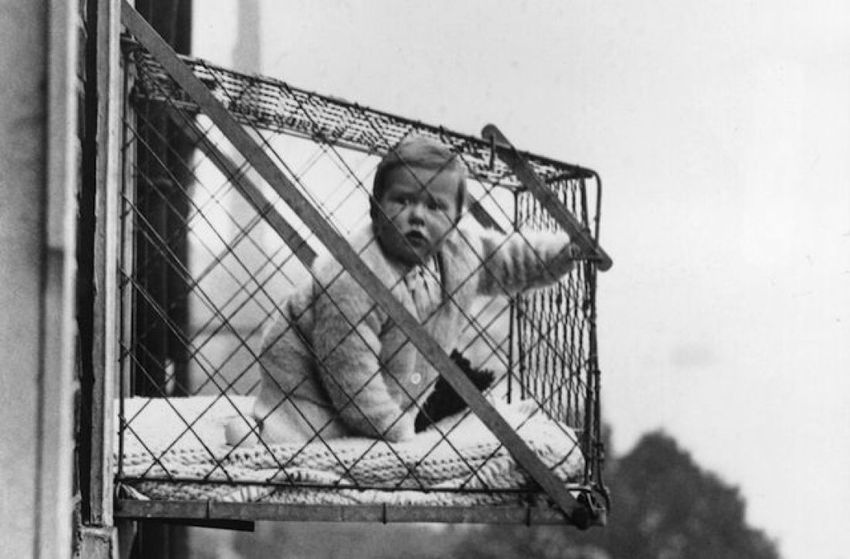

Imagine telling someone today, “I’m going to put my baby in a cage outside the window so they can get some fresh air.” You’d be met with shock, horror, and likely a visit from child protective services. In the current era of hyper-vigilant parenting and endless safety regulations, the very idea seems absurd — even criminal. Yet less than a century ago, this was not only socially acceptable in some circles but also encouraged as a way to promote infant health.
In the early 1900s, particularly in densely populated cities like New York and London, a unique parenting practice gained popularity: “airing” babies. This meant placing infants in small, cage-like contraptions that extended from apartment windows several stories high, giving the child a chance to enjoy fresh air and sunlight. While it may sound like something out of a dystopian novel, it was actually grounded in the health beliefs of the time.
Back then, fresh air was believed to be crucial for physical development and disease prevention in children. With many families living in cramped, poorly ventilated apartments, especially in rapidly growing urban centers, doctors and parents alike worried about the effects of stagnant indoor air. So, the idea emerged: if you can’t easily get your child to a park, why not bring the park air to them—by suspending them outside the window?
In 1922, a woman named Emma Read even filed a patent for a “portable baby cage,” formalizing the concept. These metal cages were designed to attach to apartment windows, allowing babies to sit or nap safely while exposed to the outside elements. They were typically made of metal mesh or chicken wire and often included a floor so the child wouldn’t fall through. The intention was noble: fresh air, natural light, and a break from the confines of tiny apartments.
Even Eleanor Roosevelt, long before becoming First Lady, experimented with one of these makeshift cages. She hung a chicken wire basket out her New York apartment window for her daughter, Anna. The neighbors were scandalized. Threats to call the authorities soon followed, despite the fact that such contraptions were not entirely uncommon at the time.
Looking back, it’s easy to laugh or cringe at the idea. In an age when parents are criticized for letting their kids play in the front yard unsupervised or for using screen time to entertain toddlers, the thought of dangling a baby over city traffic seems insane. Social media would explode with outrage. Parenting forums would ignite with shaming. The news cycle would be relentless.
But this dramatic shift in parenting norms illustrates how ideas about safety and well-being evolve. What was once viewed as progressive and even scientifically sound can, within a generation or two, become taboo. Baby cages were even featured in public service announcements and print ads, praised as a modern solution for city living. Parents were told that their babies needed exposure to the outdoors to build immunity and improve sleep patterns. Today, those needs are addressed through stroller walks in the park, supervised outdoor play, or air purifiers in the nursery.
This bizarre slice of parenting history serves as a reminder: many things we take for granted as “normal” today might be viewed as shocking or ridiculous by future generations. Parenting is always changing, often in response to new scientific research, evolving cultural norms, and shifting societal expectations.
In retrospect, baby cages are both a strange and fascinating example of how far we’ve come — and a glimpse into how creative (or desperate) parents can be when trying to do what they think is best for their children.